BotShield Actions are executed with a passkey.
A gate lets someone through — it never does the thing. An Action is the thing: a cart, a payout, a plan change, executed in place. Your customers already hold a BotShield Passkey; it came with their BotShield ID.
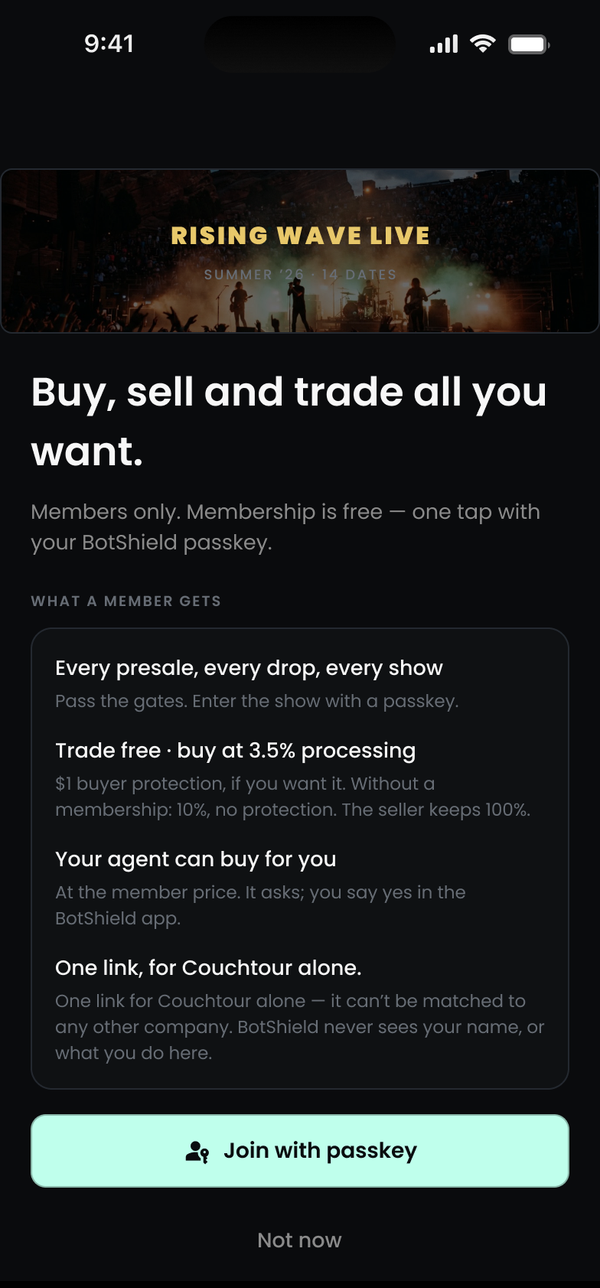
A person carts it. Humans come first.
The poster, listed at $200. A member pays 3.5% processing, plus $1 buyer protection if they want it; without a membership, 10%. The rate follows the person, not the channel. And because a cart takes a passkey, a person can take it off the table before any agent reaches it.
Carts it with a passkey.
- 01They tap Cart. It is held for them for 24 hours, and their passkey is the deposit.
- 02They buy at that price — 3.5% as a member, with $1 protection if they want it; 10% without.
- 03If the clock runs out it releases, and anyone can claim it.
Will be able to buy it outright.
- 01Humans come first. A cart takes a passkey, and only a person holds one.
- 02The mechanism is Agents Ask: the agent asks, the person says yes in the BotShield app, and a signed record comes back.
- 03A member’s agent pays the member’s rate. The rate follows the person.
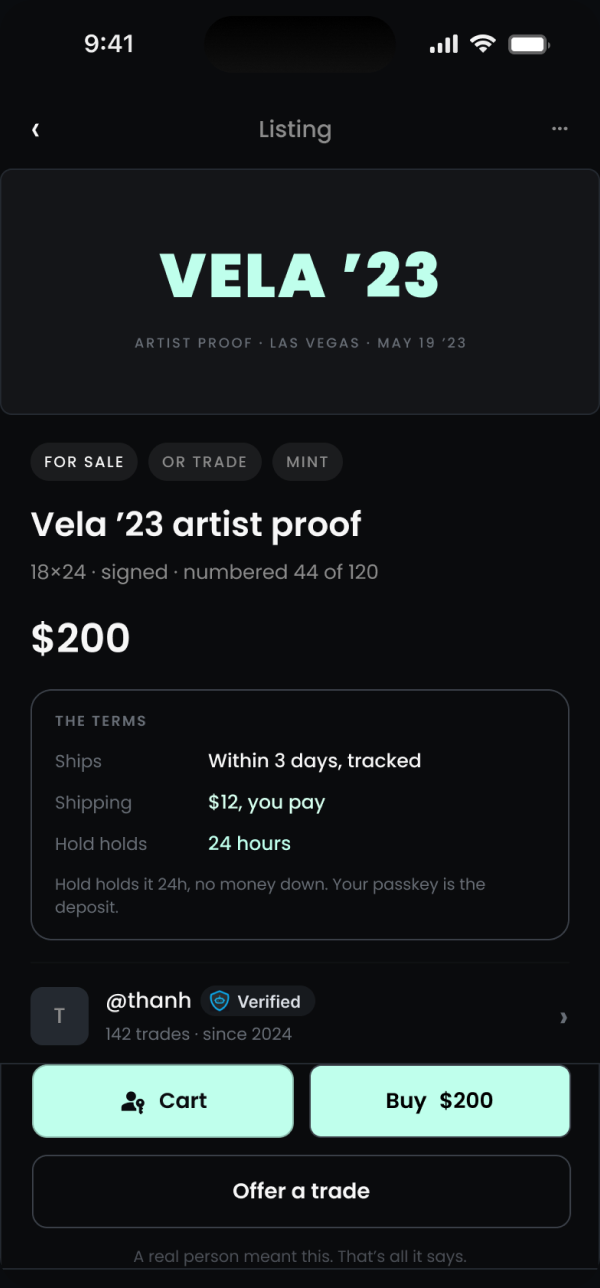
Couch Tour · a listing. The passkey holds it; the terms show what the seller gets and what the fee is.
A cart is a human move: it costs a passkey, and an agent does not have one. The seller decides everything after that — whether an agent may buy here at all is the seller’s call, and never ours.
Three facts a session cannot supply.
At the act, not the door.
A valid session says a login happened, not who is there now — shared on purpose, scripted by its owner, handed to an agent. All three are the session doing its job.
It travels.
The proof is signed and checkable by someone who was never in the room. A login is only ever worth something to the site that issued it.
It counts once.
One pass per ID, and the ID is anchored to a platform root — which is the closest thing to fairness anyone can enforce at a presale, a drop or a vote.
BotShield Actions FAQ
Can a passkey prove a real person is there?
What is the difference between a BotShield Gate and a BotShield Action?
What is the difference between a sign-in passkey and a BotShield passkey?
Can a passkey be forwarded, shared or phished?
Can an AI agent complete an action, or only a person?
What happens if someone loses their phone?
Put it behind one act.
No ID upload, no code to type, nothing to forward.
BotShield runs in your browser.
Sign in with Apple or Google, add a passkey, and approve what your agents ask — the same account the phone app will use.
Open app.botshield.ai →